Gir National Park: A Wildlife Photography Journey

Updated: Aug 22
How instincts from India's wild corridors redefined the approach to capturing definitive frames at Gir National Park.
In early 2020, while driving towards Junagadh, I noticed a Gujarat Forest Department billboard featuring an Asiatic lion. Gir soon became a place I wanted to visit. I had seen lions in zoos, but I wanted to see one moving through an open forest.

I tried to fit a Gir National Park safari into a journey towards Diu. At the counter, I learnt that no Gypsy seats remained for the core forest safari that day, so I asked about alternatives.
The staff described an enclosed area where lions moved freely in the open and said there was around a 90% chance of seeing one.
The late-afternoon drive took place in a minibus with around 20 other visitors. The lion was asleep beneath a canopy when we found it. It woke, yawned and stretched before settling again in the shade. I had a simple point-and-shoot camera with me, but it could not produce the clear frame I wanted.

At that stage, wildlife photography was not part of my travels, and I had neither the equipment nor the preparation to approach such encounters as a photographer.
The missed photograph stayed with me because the problem was not the sighting. I had been close enough to witness the behaviour, but the camera could not capture the moment clearly. Five years later, that experience would become part of the reason I returned to Gir with a different approach.
The goal was no longer to see the Asiatic lion, but to be ready when a moment lasted only a few seconds.
The Same Forest, A Different Photographer
The years that followed changed how I travelled. Photography became part of my journeys, first through landscapes and then through forests, wetlands, coastlines and wildlife habitats.
By March 2024, wildlife photography had become part of my travels. I returned to Gir with the Nikon Z7, a camera I had chosen for landscapes, coastlines and general travel rather than dedicated wildlife work. Gir would test it in conditions I had not yet learnt to handle.
We found a lion resting in a sunlit clearing, with dense branches filling the space between the Gypsy and the animal. The lion was still, but the vegetation made it difficult to acquire focus.
The encounter showed me that even a still subject could demand more from the camera and photographer than I was prepared to give.

Another evening brought a different kind of challenge. Five lions moved along the track at dusk, with two stopping to scent-mark trees before the group continued. The fading light and moving subjects left little time to acquire focus and compose the frame.
I managed a short video, but the movement of the Gypsy made it jerky. The photograph I wanted never came together. The encounter made the gap clearer: wildlife photography required me to recognise a developing moment and respond before it passed.
The Z7 was not the wrong camera. I had chosen it for the kind of photography I was doing at the time, and it performed well in those conditions. Gir had pushed me towards a more demanding form of wildlife photography.
The camera was only part of the equation. I also needed more practice with moving subjects, changing light, obstructed views and different shooting distances. That led me to the Nikon Z8 and a year of field practice across Kanha, Panna, Satpura, Keoladeo and Manglajodi.
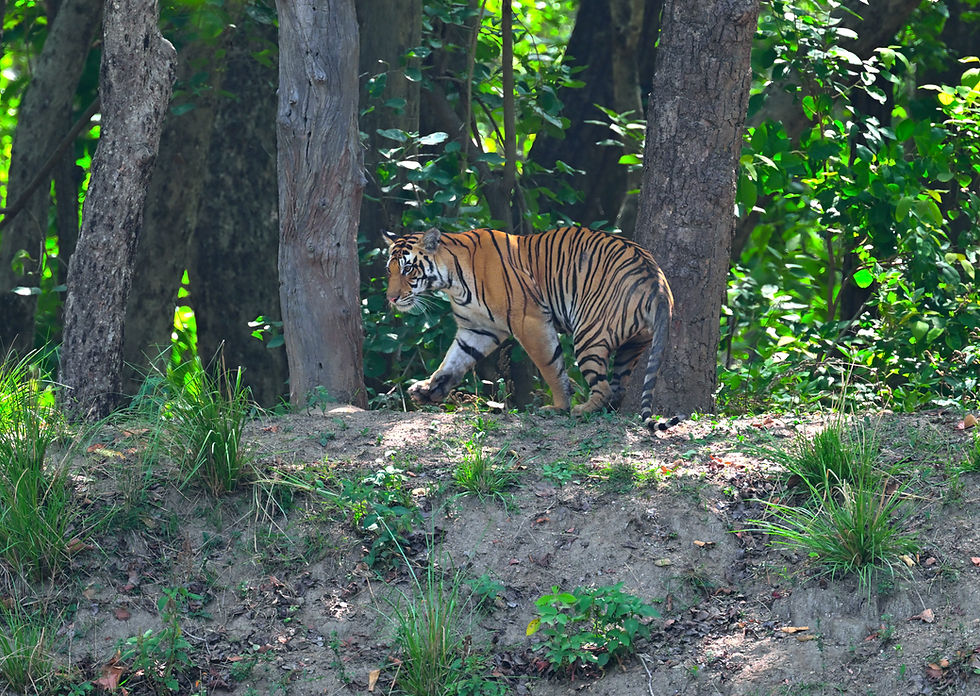
The Z8 gave me a new set of capabilities to learn, but the camera alone could not close the gap. Each safari gave me opportunities to work with movement, vegetation, changing light and distance while learning when to anticipate a shot and when to let it go.
By the time I returned to Gir in 2025, the objective had changed. I was no longer testing whether the camera could photograph wildlife. I was returning with a year of field practice and a clearer understanding of what the moment demanded.
The Season That Brought the Forest Into Focus
The return to Gir was shaped by a visual memory from 2020. I had seen lions resting beneath a canopy, close enough to watch their behaviour, but my point-and-shoot camera was not ready for the encounter.

Five years later, I wanted the forest itself to remain part of the photograph. The choice of season became important because Gir changes sharply as the dry months progress, altering both the landscape and how easily a lion can stand out from its surroundings.
I chose mid-April because I wanted to photograph Gir under conditions that would reveal the forest's character and the Asiatic lion’s camouflage. Parched ground, dry grass, fallen leaves and muted vegetation created a restrained palette across the landscape.
The lion’s coat does not simply contrast against this terrain. It can merge into it, especially when the animal rests beneath trees or moves through dry vegetation. The photograph then depends on how the subject sits within the landscape, not only on finding the animal.

The April conditions also brought stronger visual separation between sunlit ground and woodland shade. Dry vegetation could obscure a resting lion in one view and reveal it against open earth in another, making the surrounding habitat part of the photographic decision.
A greener forest would have changed that relationship, while softer seasonal vegetation would have reduced the dry, muted palette I wanted to explore. The objective was not to find the most colourful version of Gir, but to return when the forest and the lion could occupy the same visual language.
The season solved one part of the problem. Gir still offered a much larger question: how could I cover enough of the forest to find the moments I had returned to photograph?
Covering Gir National Park: Routes, Repetition and Distance
Choosing the season solved the environmental part of the plan, but it could not determine where the lions would appear. Gir’s safari routes cover different stretches of the forest, so covering different areas became important for the kind of photographs I wanted.
A single route could produce a memorable encounter, but it could also mean hours in habitat that offered no photographic opportunity. Across twelve safaris, the same route appeared on six or seven occasions, making repeated routes an important part of the challenge.
The route problem surfaced on my second safari. The guide asked if I had the permit from the previous day, explaining that the forest officer could look at both permits and consider changing the route. I had the earlier receipt in my camera bag.
With time before the morning safari, we walked to the forest officer beside the Sinh Sadan counter. I showed the previous and current day’s permit receipts, both carrying the assigned route, and the officer changed the route for that drive.

The same situation arose on two or three later occasions. Each time, I showed the previous and current permits, and the officer in charge helped us avoid repeating the same route. Sometimes another route was assigned, while on other occasions I was asked if I had a preference.
That chance suggestion changed how I approached the remaining drives. I could not choose where a lion would appear. I could, however, experience more of the forest by checking the route before each safari and asking about alternatives when a repeat came up.
Devalia added another dimension to the plan. In 2020, an enclosed safari area had been my alternative when no core-forest Gypsy was available. In 2025, I returned there by choice, using the shorter safari as a supplementary drive rather than a substitute for the core forest.
On the first morning there, I encountered Devraaj, a well-known Gir lion with a heavy mane and a facial profile that gave him a distinctly African appearance. He sat in the early morning light, offering a strong wildlife moment before the day had properly begun.

The experience also reinforced why I did not want to treat Devalia as a substitute for the core forest. The two offered different ways to experience Gir, and the shorter drive could provide another encounter while leaving more time for the forest landscapes I wanted to capture.
I also spread the drives across different timings and days where possible, rather than treating every safari as the same photographic attempt. Core-forest drives remained the main focus, while Devalia added another type of encounter and a different pace to the trip.
The route changes gave me broader coverage. Devalia added another type of encounter. But more varied drives could only put me in front of more opportunities. The next problem was being ready when one appeared.
When the Forest Offered the Moment
A recent lion sighting led us towards an artificial waterhole deep inside the forest. The area had tall trees around the water, creating shade for the animals and openings that let the forest remain part of the frame.
I was watching the waterhole when a lioness emerged from the dry vegetation, followed by three small cubs.

The family moved towards the water, and another lioness appeared with three more cubs. Within moments, the group gathered at the edge of the waterhole.
The scene brought several elements together at once: the lions, the dry forest, the water, and the family's movement.

The photograph mattered for more than the number of lions in the frame. It preserved the relationship between the family and its surroundings, which was the kind of image I had returned to Gir to make.
The encounter also showed what the preparation had changed. I was no longer approaching a sighting as a traveller hoping to record whatever unfolded around me. I was watching the light, the movement, the surroundings and the moments that could disappear within seconds.
The forest had finally offered the kind of scene I had been pursuing since 2020. This time, I was ready to respond.
What Being Ready Actually Meant
The months after the 2024 Gir safaris became a period of field practice. I used the Z8 across different habitats, learning how to respond when movement, light, vegetation and distance changed within a scene.
One of those situations came in December 2024 at Madhai in Satpura Tiger Reserve. A tiger was moving through tall grass while a peafowl stood in the foreground, giving me two subjects to follow within the same frame.

The situation required more than keeping the tiger sharp. I had to follow its movement while retaining the peafowl and enough of the grassland to show where the encounter was taking place. The Z8 gave me the tools, but the practice helped me use them with greater confidence.
That distinction mattered when I returned to Gir. The problems I had faced in 2024 had not disappeared. Moving subjects could still test focus, branches could still interfere with tracking, and changing light could still narrow the margin for error.
What had changed was my response. I had spent months working with moving subjects, different distances, changing light and obstructed views. I had a better sense of when to adjust, when to hold the composition and when a moment was about to pass.

The Z8 had become part of that process, but it was not the whole answer. The return to Gir was the first time I could bring the equipment, experience and preparation together.
What the Return to Gir Changed
The return to Gir was not about correcting one missed photograph. The years between the two visits had changed how I looked at wildlife, from waiting for a subject to recognising what was happening around it.
I had learnt to watch behaviour before reaching for the shutter. A mother becoming cautious, an animal changing direction, or a brief shift in light could alter the photograph within seconds.

The equipment mattered, but it worked best when I understood what the scene demanded. The Z8 gave me more confidence with moving subjects, changing light and difficult backgrounds, while the experience of working across different forests taught me when to adjust and when to let the moment unfold.
That difference became clear during the return to Gir. I was no longer trying to make every sighting fit the photograph I had imagined before entering the forest. I could respond to the animal, the light and the surrounding habitat as they changed.
Five years earlier, a lion waking beneath a canopy had left me with a memory I could not preserve as I wanted. In 2025, I returned with a different camera, more field experience and a better understanding of what wildlife photography demanded.

The photograph I wanted in 2020 was never just about a lion. It was about seeing the animal within the forest and preserving the behaviour that made the encounter worth remembering. Returning to Gir taught me that the camera could record that relationship only when I was prepared to see it first.
The missed frame from 2020 therefore became part of the photograph I eventually learnt to make. Not because I recreated that moment, but because it changed how I approached every moment that followed.


![[cite_start]Expansive 20mm wide-angle landscape of Anayirankal Dam backwaters in Kerala, with lush tea plantations, a tranquil lake, and misty mountains. [cite: 73, 74]](https://static.wixstatic.com/media/f31e44_1b39e651c8aa4241a6cfd940b53ab21d~mv2.jpg/v1/fill/w_980,h_653,al_c,q_85,usm_0.66_1.00_0.01,enc_avif,quality_auto/f31e44_1b39e651c8aa4241a6cfd940b53ab21d~mv2.jpg)