The 100–400mm Telephoto Sweet Spot in Field Use

Updated: Feb 28
Living with a 100–400mm reshapes how distance, scale, and context work together. A field-based reflection across landscapes, wildlife, and action.
Telephoto lenses draw attention the moment they leave a camera bag. Their length signals intent, even to those who do not photograph.
Short-form video platforms amplify this perception, compressing months of fieldwork into a few seconds of tight frames and distant subjects pulled close. The purchase feels justified. The reality often arrives later, when those moments refuse to repeat outside curated clips.

This post traces the choices and trade-offs that shape a telephoto decision when ownership replaces aspiration. Specialised lenses demand more than money. They demand time, patience, and acceptance of limits. When the lens costs more than most travel budgets, each decision carries weight.
Why This Is Not a Gear Story
A chef chooses knives based on repetition, not novelty. Each blade earns its place through use, not promise. Photography works the same way. Lenses shape decisions long before a frame forms, and those decisions come from habit, not hype.
A mid-range telephoto follows a similar path. Its value comes from compromise rather than excess. Reach trades against weight. Speed trades against cost. Portability trades against specialisation.

I shoot across long travel days, changing terrain, and uncertain light. My work moves between mountains, forests, and human spaces without controlled access or predictable conditions. The lens I carry must survive that rhythm. This section explains why that reality matters more than specifications.
What a Telephoto Sweet Spot Really Means
Telephoto lenses cover a wide range of focal lengths, from moderate reach to extreme distance. Fixed focal lengths prioritise speed and isolation. Variable focal lengths prioritise flexibility. Each choice narrows one set of problems while opening another.
My work began in the mountains, where compression matters more than scale. I needed a focal length that could isolate ridgelines, temples, and distant settlements without pulling me out of the scene. Later, wildlife demanded reach during low light, often at dawn and dusk, where patience matters more than proximity.

Travel adds another constraint. I carry gear across uneven roads, forest tracks, and long days on foot. Weight sets limits before image quality enters the conversation. Cost sets limits before aspiration does.
The telephoto sweet spot sits inside these pressures. It does not solve every problem. It solves enough of them to let work continue.
Telephoto Landscapes Are About Compression, Not Drama
Most landscape instruction begins with width. Wide and ultra-wide lenses promise scale, sky, and foreground tension. Telephoto landscapes work in the opposite direction. They reduce space instead of expanding it. They stack elements until distance turns into structure.
Compression reshapes how a scene reads. Distant ridges align. Rivers trace quieter paths. Architecture settles into its surroundings rather than dominating them. The frame stops chasing spectacle and starts building relationships.

Reach alone does not define this approach. Excess distance introduces haze, soft contrast, and loss of detail. Control matters more than reach. Compression works best when restraint guides it.
Choosing a System Without Chasing Extremes
I shoot on the Nikon Z mirrorless system, and my telephoto decisions sit within that ecosystem. While the lens names belong to one brand, the trade-offs mirror those faced by photographers using Sony or Canon. Every system offers extreme reach and flagship optics. The challenge lies in choosing what fits sustained use.
My need for a longer telephoto surfaced after early wildlife work pushed the limits of a 70–200mm f/2.8. Reach mattered, but the jump to super-telephotos raised questions about cost, weight, and how I travel. Research narrowed the field to five options spanning mid-range zooms, long primes, and flagship super-telephotos.

At one end sat the 400mm f/2.8 and 600mm f/4 with built-in teleconverters. These lenses delivered unmatched image quality and dual focal length flexibility, but their size, weight, and price placed them outside my working reality. Carrying them would reshape how I move, shoot, and travel.
The 800mm f/6.3 PF offered reach at a lower weight, yet its bulk, single-purpose nature, and transport demands conflicted with a workflow that shifts between landscapes, wildlife, and people.
That left a clearer decision between two lenses: a 400mm f/4.5 prime and a 100–400mm f/4.5–5.6 zoom. The prime delivered stronger subject isolation and cleaner files.
The zoom traded some optical purity for flexibility, closer focusing, and lower cost. It also covered the focal lengths I reach for most often, without forcing a commitment to a single way of seeing.
I chose the 100–400mm because it aligned with how I shoot across long travel days, changing subjects, and unpredictable access. The choice favoured continuity over extremes.
When Scale Becomes a Human Story
Telephoto lenses excel when scale needs context rather than isolation. Reach does not always mean tightening the frame. It can also mean holding distance while compressing relationships within it.
This image from Rameswaram shows the country’s tallest TV tower. A longer focal length would invite a tighter crop, pulling the structure out of its surroundings. Instead, the frame sits at 175mm.

At the edge of the frame stands the Ramanathaswamy Temple, reduced to a small triangular form. The compression places both structures in the same visual plane. The tower dominates without explanation. The temple provides scale without competing for attention. The relationship between the two tells the story.
Action Without Excess
Mid-range telephoto zooms suit outdoor sports where distance shifts and light remain consistent. In July 2025, I photographed the Champakulam Boat Race, Kerala’s oldest snake boat race, held on the Pamba River in Alleppey district.
I positioned myself near the starting stretch, where the river spans roughly 100 to 150 metres. That distance defined the work. At the wider end, the frame held the river’s breadth and the alignment of boats.

At the longer end, it isolated oarsmen, lifted paddles, and bursts of water as boats surged forward. The same lens carried both views without forcing a change in position.
One frame shows a boat pulling past another, oars raised in mid-stroke. The compression holds multiple boats in a narrow plane, while water spray signals motion without overpowering the frame.

Another image expands the context, bringing spectators on the opposite bank into the scene. Action and audience share the same moment.

Balance matters in situations like this. The Nikkor Z 100-400mm f/4.5-5.6 remains centred even when fully extended, which supports handheld shooting over long periods. Paired with a larger body like the Nikon Z8, the setup stays stable enough to work at slower shutter speeds while tracking movement across the frame.
When the Reach Feels Short, but the Frame Feels Right
Reach does not always arrive when needed. In wildlife, even the longest focal length can feel insufficient. Distance, behaviour, and light rarely align on demand.
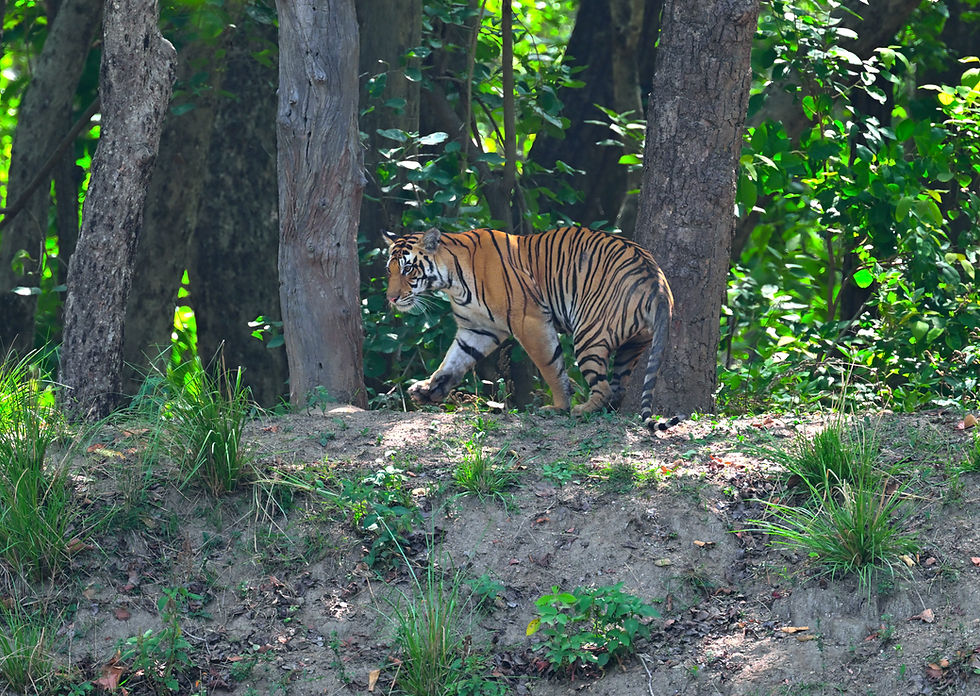
During an evening safari in the Turia zone of Pench National Park in summer 2025, light faded as we approached exit time. Near a small pond bordered by a dense canopy, a tiger family emerged from cover. One cub paused near the bank and stretched its body.

From our position, the cub remained small even at 400mm. A fallen log stood behind it. The pond edge sloped away, placing grass in the foreground, the cub and log in the middle ground, and dry soil with scattered leaves beyond. Compression held these layers together without forcing proximity.
A tighter frame would have isolated the animal and stripped the moment of place. The distance preserved scale. The cub stayed part of the forest rather than being pulled from it.
Telephoto lenses reward restraint as much as reach. When distance remains, context carries the story.
Living With One Focal Length Over Time
Living with a single telephoto over years shapes more than images. It shapes decisions. The 100–400mm carried me across landscapes, wildlife encounters, sport, architecture, and human stories without demanding constant change.
Working within its narrow field of view expanded how I see. Distance stopped feeling like a limitation and started acting as a filter. Scenes asked for patience. Frames asked for intention. The lens did not chase moments. It waited for them to settle.

That familiarity matters more than reach. Over time, constraints reveal patterns. The work improves not because the lens changes, but because the photographer does.
![[cite_start]Expansive 20mm wide-angle landscape of Anayirankal Dam backwaters in Kerala, with lush tea plantations, a tranquil lake, and misty mountains. [cite: 73, 74]](https://static.wixstatic.com/media/f31e44_1b39e651c8aa4241a6cfd940b53ab21d~mv2.jpg/v1/fill/w_980,h_653,al_c,q_85,usm_0.66_1.00_0.01,enc_avif,quality_auto/f31e44_1b39e651c8aa4241a6cfd940b53ab21d~mv2.jpg)

