Khirsu, Uttarakhand: Where the Ghost Village Still Breathes
- Subhashish Chatterjee

- Dec 27, 2025
- 10 min read
Updated: Feb 15
A return to Khirsu shows what endures in a ghost village where views change, yet stillness and memory stay. A story of place, time, and quiet resilience.
I reached Khirsu on a cold November morning in 2018 after a gradual climb through pine and deodar forests above Pauri. The road narrowed near the ridge, and the light thinned between tall trunks before opening into a line of terraced fields.
A few houses stood apart with swept courtyards, closed doors and quiet footpaths between them. Locals said around 80 residents lived here at the time, just enough to keep life going without filling the place with sound.
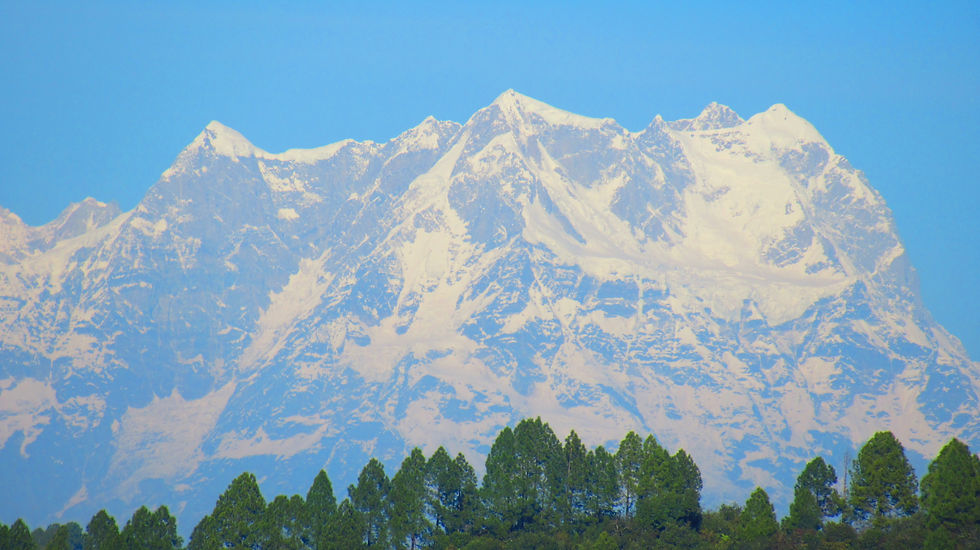
Higher up the slope, the Garhwal Himalayas rose across the northern skyline in a long, unbroken line. They felt close enough to draw the eye and distant enough to belong to a larger world beyond the village.
I stood there until the cold settled on my hands before crossing the grounds in silence.

Six years later, in April 2024, I returned to the hills near Pauri for a quiet stretch of work with no fixed plan. My solo journeys continued through those years, but the places I spent time in began shaping how I worked with landscape and light.
On my first evening here, the skyline reminded me of Khirsu, and the idea of returning felt instinctive. I decided to go back and see what time had carried forward in Khirsu and in me. What follows traces that return and what surfaced along the way.

Why Khirsu Drew Me in 2018
In the early 2000s, many high-altitude villages in Uttarakhand, including parts of Garhwal, saw families leave in search of work that no longer reached these hills. Doors were locked, homes closed, and movement shifted towards cities such as Dehradun and Delhi.
Khirsu was one of the places where this was felt strongly. By 2018, it was said that around eighty residents remained.
Walking Into a Village That Felt Paused
I arrived in Khirsu on a winter morning after a shared taxi ride from Pauri, a Bolero MUV that runs fixed routes in the hills. Mornings in such places hold a steady rhythm: schoolchildren gathering, shops opening, buses readying for the return to town.
At Khirsu’s entrance, that pattern was missing. The small parking area, also used as a taxi stand and bus stop, had no movement besides our arrival. I was the last passenger to get off the Bolero. The driver locked the vehicle and began packing away a few things in the front seat.
When I asked whether he would wait long before heading back to Pauri, he nodded towards the empty road. “Not many leave at this hour. Most take the early bus,” he said. “I will rest and see if someone comes by afternoon.”

I walked past a closed dhaba near the entrance and followed the road into the village. Houses stood close to the roadside with gates fastened, and verandas swept clean. The path showed the wear of regular use, yet nothing seemed to disturb its surface that morning.

A stillness filled the space between buildings, not empty but held in place as if life here had paused and stayed that way.
Reaching Khirsu: A Road That Refused to Change
Pauri is a busy town and a practical halt for travel deeper into Garhwal. The narrow road through the main market leads towards the bus station and taxi stand, and by seven in the morning the traffic already feels pressed. Our shared Bolero moved slowly through the turns, waiting between vehicles and pedestrians before reaching the outskirts.
Beyond Pauri, the pace shifted. The road narrowed into the forested Khirsu Range, and the air grew cooler under tall trees that filtered the early light.

Windows stayed open, and the wind carried a damp freshness that felt different from the dust of the climb behind us. The taxi moved steadily through the bends as the forest gathered on both sides.
My journeys to Pauri six years apart were long in different ways. Back in 2018, the Char Dham Highway Project was widening routes towards the higher shrines, and the work brought traffic jams and constant dust.
In 2024, deep tunnelling on the Rishikesh–Karnaprayag rail line project slowed movement again, and a thick blanket of dust made it difficult to keep the window even slightly open.
Further into the Khirsu Range, the road felt almost the same. The surface showed wear, the bends held their shape, and the forest met the wind in a way that eased the senses after town.

The village stood beyond this stretch, but the road itself offered a pause before arrival. It was less about what had changed, and more about what had not.
November 2018: When Khirsu Opened to the Himalayas
In late 2018, travel apps showed no accommodation options for Khirsu. The only place to stay was the state-run tourism rest house operated by Garhwal Mandal Vikas Nigam (GMVN). Sparse reviews and a handful of photos suggested two things that mattered to me: a clear Himalayan panorama and simple Pahadi meals.
GMVN’s website at the time was basic but functional. I found the Khirsu listing, booked a room, and arrived a few weeks later.
GMVN Khirsu stands about 400 metres beyond the village entrance. A wide gate marked with GMVN confirms the turn. The approach rises gently before opening into a long strip of land used as the parking area.
The main grounds lie to the left. On a slope descending toward the village edge, the rest house is arranged in two tiers: the white main block trimmed in green on the upper level and a row of cottages on the lower.
A landscaped garden fills the space between them, with cemented paths leading down toward the cottages. From the elevation of the main building, the land opens without obstruction.

Before checking in, I set my rucksack on the grass near the garden and walked to the open edge. The Garhwal Himalayas rose across the northern skyline, clear against the autumn light, the garden falling away in front of me to the roofs of the village below.

I returned to the garden after leaving my bag in the room. A plastic chair faced the view. The caretaker who brought tea stood beside me and named the peaks from west to east, pointing with a steady arm: Chaukhamba, Kedarnath, Neelkanth, Trishul, Nanda Devi, Swargarohini, Bandarpunch, Kalanaag, and the Gangotri group beyond.

He said the visible stretch covered close to 300 KM on a clear day. The space between my chair and the horizon felt open, without rooftops or terraces competing for sightlines.
It was the most unobstructed Himalayan panorama I had seen from an accessible village stay.

Chaukhamba, with its four summits rising in a tight formation, brought back a memory from the start of that trip when I saw it from Chandrashila.
Here in Khirsu, the massif felt sharper, as if the ridge below carried the line of sight straight toward it.
Later that afternoon, I walked toward the far end of the grounds and then down to the village entrance for lunch. The small dhaba near the taxi stand, shuttered earlier that morning, had opened by then. A plate of daal-chawal, cooked without hurry, matched the pace of the day.

I returned to the garden before sunset. Light shifted across the peaks, first pale, then warm, before fading into dusk. It remains one of the clearest sunsets I have watched: steady light, a wide horizon, and no movement to draw the eye away.

The College That Held Its Ground
On my second evening in Khirsu in 2018, I walked past the village houses and reached the grounds of the State Government Inter College, the local rural school offering education from Class 6 to Class 12.
The open field stretched toward a wooded hill, with oak trees tracing its boundary. A football match was underway, and the sound of the ball striking the ground carried through the still air. Light faded behind the slope while the players kept at their game.

When I returned in 2024, I passed the inter-college again. Students were stepping through the gate as school ended for the day, their voices drifting across the road. The grounds looked familiar, and the hill stood in the same line behind them. Afternoon light spread across the field much as I remembered.

In a village where many homes had closed over the years, the college continuing its classes gave a sense of rhythm that outlasted departures. It was not bustling activity, but a steady presence that held through time.
Small Eateries: Fading and Returning Through Memory
The dhaba near the entrance and the small tea shop where I stopped in 2018 were gone when I returned in 2024. Six years is enough time for shutters to close in the hills, especially in a village where many homes have stayed locked. Their absence felt expected rather than abrupt.
Near the inter college, I found a blue-painted house with its front room set up as a dhaba. A few chairs stood by the window, and light from the road fell across the counter.

I had eaten before arriving in Khirsu that morning, but the place felt familiar in a way I could not place. I ordered a chai and a bread omelette and sat near the doorway.
The air was cool inside, and the warmth of the glass settled into my hands. The first sip carried a memory of another cup on a colder evening years earlier, when I had paused in Khirsu for the first time.
The taste felt unchanged even though the place had shifted. What returned was not the shop, but the moment.
April 2024: Returning Without the Mountains
April 2024 marked a return to the hills near Pauri without a plan to move around. A small property on a slope above the road became the base for the days ahead.
The land opened toward the same Himalayan line once visible from Khirsu, though the peaks stayed unseen throughout the stay. The caretaker mentioned that April often brings clear mornings, yet each day the horizon held its haze.
Days settled into a slow rhythm: first light touching the ridge, evenings falling behind the slopes, and long hours spent on the veranda watching weather pass across nearer hills without revealing anything beyond. With the peaks hidden, attention stayed close to what lay within sight.

A clearer morning offered a reason to leave the cottage. A day trip to Khirsu felt right, and the bends through the Khirsu Range held the same breaks in light as before.
Near the village entrance, a few new buildings stood close to the small square where the shared taxi had once dropped passengers. Others showed signs of construction, though the pace around them remained unrushed.

At the GMVN grounds, the air carried the same stillness remembered from earlier years. The adjoining road offered a different angle toward the horizon, but the haze stayed through the afternoon.

Light shifted across the slopes and shadows stretched along village paths, yet the mountains did not appear. What once filled the distance stayed out of sight, even as the place around it held a familiar shape.
Post-Pandemic Attention: And Why It Didn’t Last
At the dhaba, while waiting for chai and a bread-omelette, I spoke with the owner about how travel patterns had changed since the pandemic.
He said a few new homestays opened offering modern comforts close to the village square. Visitors did arrive, curious about Khirsu’s reputation as a quiet place with wide Himalayan views, yet the momentum never lasted long enough to reshape the village’s fortunes.

Many travellers came for a day, drawn by the idea of a ghost village and an easy break from busier towns. They explored for a few hours and moved on.
Khirsu lacked the familiar structure of a busy hill station. Without a central market or activity loops to move through, the village invited stillness more than motion. For some visitors, that meant there was little to stay for once the first impressions settled.

The renewed attention was brief, and the stillness that defined Khirsu remained largely unchanged. In a travel landscape where places can surge through short bursts of visibility, Khirsu held its ground quietly, shaped more by what it did not offer than by what it did.
Khirsu Is Not a Viewpoint. It Is a Pause
Wide Himalayan views once made Khirsu known. The view arrived with certain seasons and vanished with the weather, but its presence was never the whole story. What lasts is an unhurried pace that continues without spectacle, held together by those who never left.
Doors stay locked, fields stay tended, and the school bell still rings. The village feels shaped less by what slipped away than by what endures in the hands of those who remained.

Khirsu may never perform for tourists, yet it leaves space for those who arrive without demands. Not every place needs to change for its worth to be felt. Some simply remind you to slow down long enough to notice what has not disappeared.


Comments